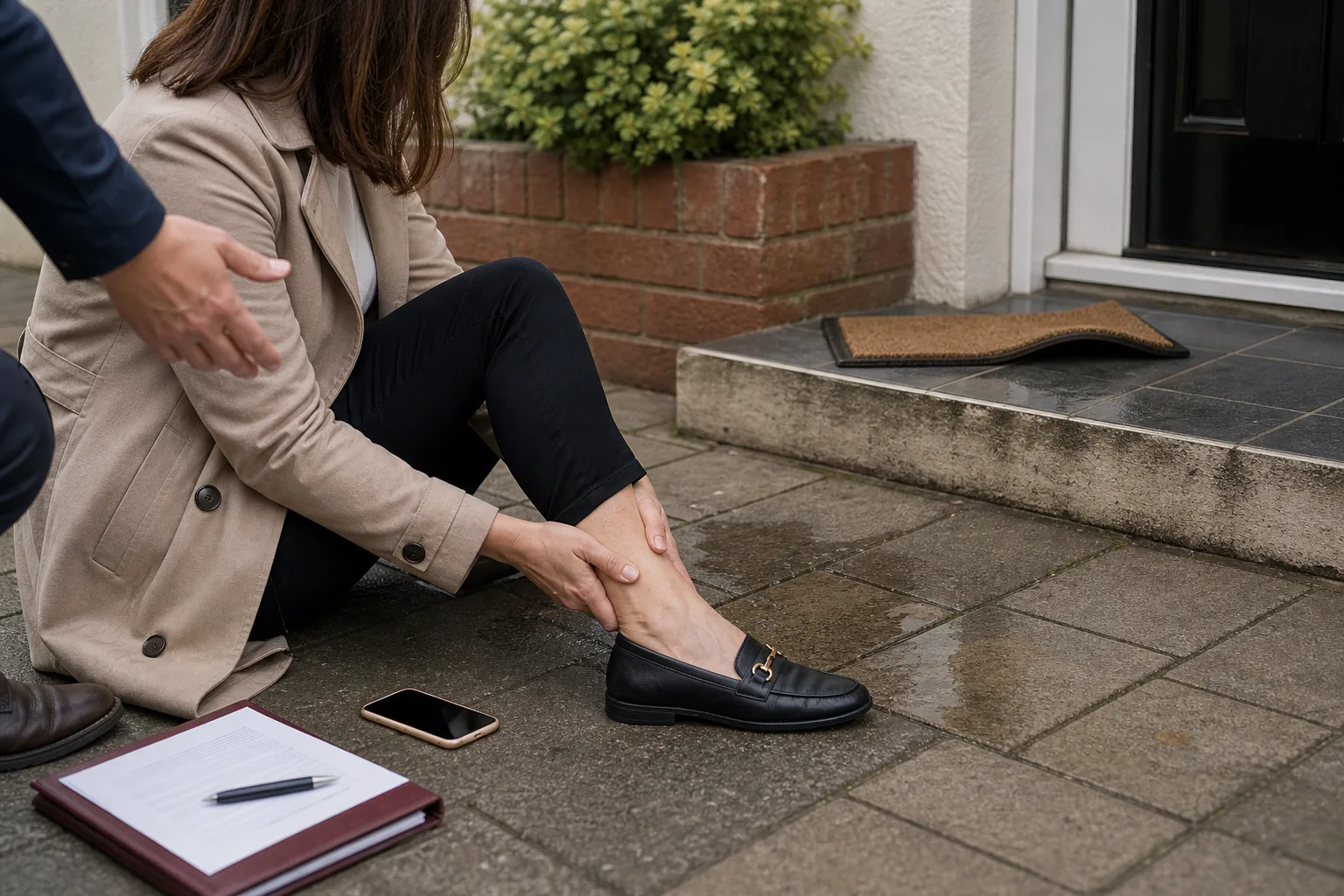
WHAT IS AN ACCIDENT ON PRIVATE PROPERTY CLAIM?
When you're injured on someone else's premises, the law expects them to have kept you reasonably safe.
An accident on private property claim lets you seek compensation when you're hurt on land or in a building someone else controls — a friend's home, a landlord's flat, a private car park, a shop or office. Under the Occupiers' Liability Act 1957, the person in control of the premises (the "occupier") owes lawful visitors a duty to take reasonable care to keep them reasonably safe. A more limited duty can apply to trespassers under the Occupiers' Liability Act 1984.
If your injury was caused by something the occupier should have sorted — a defective step, an unlit stairwell, a wet floor with no warning, a falling object or an aggressive dog — you may have a strong case. Not sure what your claim might be worth? Try our personal injury claim calculator for a quick estimate, and see our wider guidance on an accident in a public place if you were hurt somewhere open to the public.
What you can claim for
Defective steps & floors
Worn, broken or uneven stairs, ramps and flooring that cause a trip or fall.
Slips & trips
Spills, wet surfaces, trailing cables or loose mats left without warning or cleanup.
Poor lighting
Dark stairwells, car parks and communal areas where you couldn't see a hazard.
Falling objects
Items stored unsafely on shelves or scaffolding that fall and injure you.
Dog bites & animals
Injuries from an out-of-control dog or animal on the occupier's premises.
Disrepair hazards
Loose railings, broken paving, faulty doors or other unrepaired defects.
You may have a claim if…
You were injured within the last three years (different rules apply for children and those who lack capacity)
The accident happened on premises controlled by someone else
The occupier failed to take reasonable care to keep you safe
That failure caused or contributed to your injury
How your claim works
01
Free consultation
Tell us what happened in a free, no-obligation chat — by phone or online. We'll let you know if you have a claim.
02
We investigate
We gather evidence: photos, witness details, accident records, CCTV and medical notes, and identify the right insurer.
03
Building your claim
We arrange any medical evidence, value your claim fairly and put it to the occupier's insurer to negotiate the best outcome.
04
You're compensated
Most cases settle without court. We secure your compensation and, under No Win No Fee, you keep the lion's share.
Accident on private property FAQs
Can I claim if the accident happened at a friend or family member's home?+
Yes — and it needn't damage your relationship. A claim against a household occupier is normally met by their home or buildings insurance, not out of their own pocket. In practice you're claiming against the insurer, who handles and pays it; many people are surprised how little it affects the person concerned.
Is this really No Win No Fee?+
Yes. We run these claims under a Conditional Fee Agreement (No Win No Fee). There's nothing to pay upfront, and if your claim doesn't succeed you won't pay our fees. If you win, a success fee is deducted from your compensation — capped at 25% of certain damages for personal injury claims. We'll explain every figure clearly before you sign.
How long do I have to make a claim?+
Usually three years from the date of the accident in England and Wales. There are exceptions — for children the three years runs from their 18th birthday, and different rules apply where someone lacks mental capacity. It's best to get advice early so important evidence isn't lost.
What if I was partly to blame for the accident?+
You may still be able to claim. Where you share some responsibility, compensation can be reduced to reflect your share (known as contributory negligence) rather than refused outright. We'll give you an honest view of how it could affect your claim.
What evidence helps an occupiers' liability claim?+
Photos of the hazard and your injuries, the date, time and exact location, names and contact details of any witnesses, and a record of the accident if one exists. Keep receipts for expenses and see a GP so your injuries are documented. We can request CCTV and other records on your behalf.
How much compensation could I receive?+
It depends on your injury and its impact on your life and finances. Awards reflect pain and suffering plus losses like earnings, treatment and travel. Figures are illustrative and a solicitor should review the facts of your case — for a quick guide, use our claim calculator or call us for a free assessment.
FREE CLAIM CHECK
See if you can claim in 60 seconds